
What if gold isn't actually getting more expensive? What if it's our money that's becoming worth less?
To understand why that might be happening, we need to talk about one of the most boring, yet revealing, parts of the financial system: the bond market.
I know. Boring as fuck. But stay with me, because understanding what's happening here might fundamentally change the way you think about money, inflation, and why hard assets like gold and silver have become so interesting (and why you might want to fix your mortgage interest rate, if you haven’t already…).
The Reserve Bank of Australia increased interest rates last week. You might be wondering why….
Central banks are the organisations charged with managing inflation. Ours is called the Reserve Bank of Australia (RBA). You may have also heard of the USA’s equivalent, the Federal Reserve (the Fed), or the Bank of England in the UK.
The board members of these organisations meet regularly to discuss the state of their economy and establish if inflation is running “too hot” or “too cold.” Each central bank has a band of inflation that they deem acceptable to achieve a balanced economy. Think Goldilocks — not too hot, not too cold.
In Australia, the RBA’s target inflation band is between 2% and 3% every year. [rba.gov.au]
If inflation is determined to be running higher than the target band, the economy is deemed to be running hot, and they have a mandate to take measures that cool it. The main tool they have to achieve this is by raising or lowering the national cash rate.
A higher cash rate increases the cost of borrowing money, resulting in higher interest rates.
That is all pretty straightforward. Most people who have ever had a mortgage will understand those mechanics one way or another.
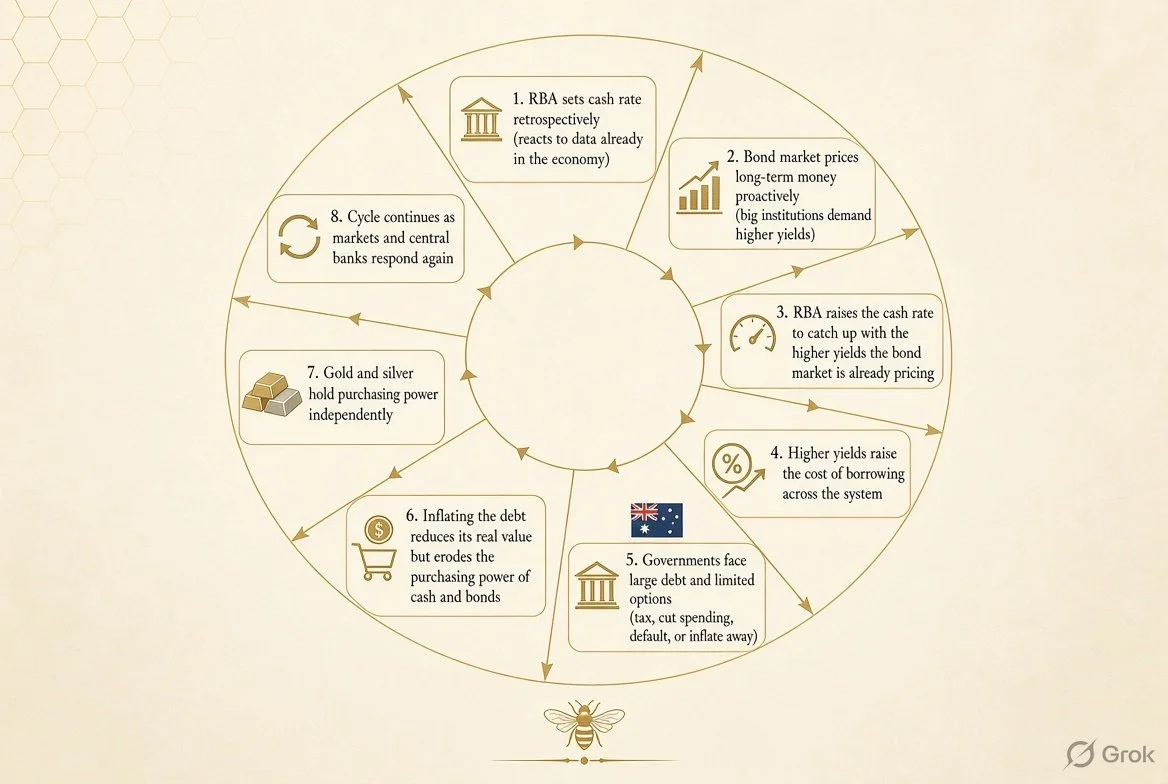
What may not be so obvious is that the central banks make cash rate decisions retroactively. They are responding to conditions that are already being experienced in the economy.
“The Board will continue to be driven by what the incoming data tells us about where the economy has been and what this means for the outlook.” [Michelle Bullock, March 2026]
This is where bonds enter the chat.
Bonds are boring as fuck, right? What even are they?
A bond is just a loan. When you buy a government bond, you are lending money to the government. They pay you interest for the privilege of using your money, then give it back at the end of the term. Terms can be a short as 1 year or as long as 30 years. The 10 year bond is the one most economists talk about.
The “yield” (cashflow, profit) is the interest rate on that loan.
Here’s the bit that actually matters to you:
The bond market is where big money (pension funds, superannuation funds, banks, foreign governments, hedge funds - the institutions who actually buy them) decides what interest rate they’re willing to accept to lend to your government.
If those big players start demanding higher yields — meaning they want more interest to ensure the repaid amount is at least equal in purchasing power to the amount they originally invest — the cost of borrowing rises across the whole system before the RBA even meets.
Mortgage rates, business loans, credit card rates — everything feels it - because it is these large institutions who have the money to lend.
The RBA can set the overnight cash rate. They cannot set the price of long-term money. The bond market does that. So, in short, the bond market is pricing interest pro-actively. It looks into the future at what the trend is doing, and prices that into the amount of yield they need in order to lend today. This is exactly the opposite of what the RBA does, as we’ve explored above, who price the cash rate retrospectively based on what has already happened.
So when the bond market starts pricing in higher yields, the RBA is often just catching up to what the market has already decided.
That’s the part most people never get told.
Let me say it again - the RBA is catching up to what the market has ALREADY DECIDED.
This is where it gets interesting. And a bit uncomfortable.
Have you ever maxed out a credit card, then rolled it onto a new card with a slightly higher interest rate? Then maxed that one out, and rolled it onto another one? You’re paying the minimum amount each month, but you don’t seem to be reducing the amount of debt…. IT JUST SEEMS TO BE GETTING BIGGER AND BIGGER.
That is essentially what Western Governments are doing right now…
Governments (ours included) have a lot of debt (Australia just tipped 1 trillion, the USA is over 40 trillion). That debt is mostly in the form of bonds. They borrowed money by selling bonds. Now they have to pay interest on those bonds and eventually repay the principal.
When interest rates rise, the cost of servicing that debt rises with it. More of the budget goes to interest payments instead of roads, hospitals, defence, or whatever else people actually want.
Governments have a few options when the debt gets heavy:
Raise taxes.
Cut spending.
Not pay - called ‘default’ (rare for a developed country, but not impossible).
Or inflate the debt away.
Inflating the debt away is the quiet option - because the electorate rarely votes in a government who will raise taxes and/or lower spending (think the current outrage at the Albo/Charmers 2026 budget or the Abbot/Hockey budget of 2014).
If the government creates more money (or allows the central bank to), that is inflationary and your currency loses purchasing power. The dollars they eventually use to repay old bonds are worth less IN REAL TERMS than the dollars they borrowed (hence the demand for higher yield to cover this). In real terms, the burden of the debt shrinks.
Bondholders get their money back, but it buys less - it is worth a lesser amount by the time they get it back.
That’s not a conspiracy theory. It’s the reality of a fiat based economy.
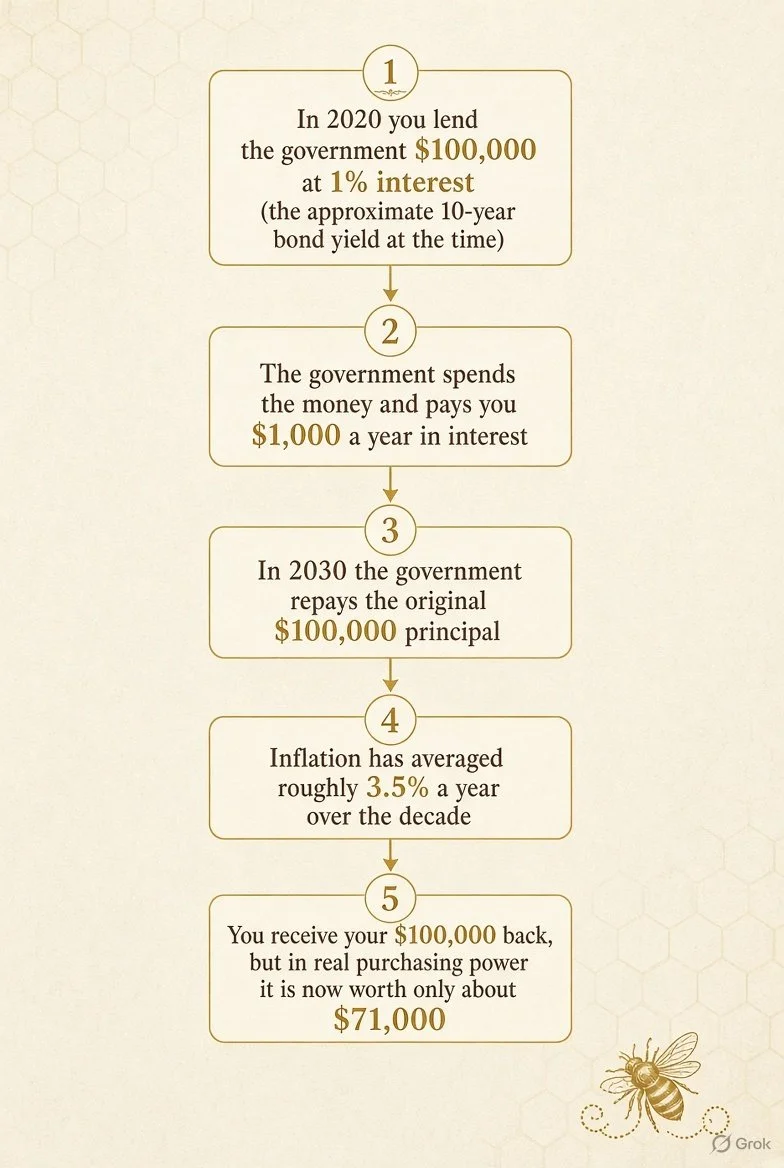
It’s also why a lot of people who understand the bond market start looking at hard assets when government debt gets large and yields start rising. Because, why would anyone invest in Bonds knowing that their capital would be worth less by the time it’s repaid?
The bond market is currently pricing in higher yields. If governments respond by creating more money (or letting inflation run hotter than the target band), the real value of the currency declines. That’s the part that eventually shows up in your grocery bill, your rent, and the purchasing power of any cash you hold.
Its why you now go into Coles with $100 and leave with 8 items.
Gold doesn’t care what the official cash rate is. It doesn’t care what the government says the inflation number is. It has done the “store of value” job for a very long time, including through periods when governments have used inflation to lighten their debt load.
Last week the US President said something unusual out loud.
“Certain levels of inflation will also pay off that debt very rapidly. Very rapidly.”
D.Trump, Times Magazine, 1st October 2026
He was talking about the US national debt. 40 Trillian of it.
What he meant is exactly what I described above. If inflation runs hotter than the interest rate on the debt, the real burden of what the government owes shrinks. The dollars used to repay old bonds buy less than the dollars that were originally borrowed. Bondholders still get their money back on paper. It just doesn’t go as far.
He also said higher interest rates were hurting the country more than inflation. This demonstrates the currency death spiral that they (and the wider Western Economy) is currently facing.
Keep rates high to fight inflation and the interest bill on the debt grows.
Let inflation run a bit hotter and the real value of the existing debt declines, but everyone who holds cash or bonds loses purchasing power in the process.
For a reader in Australia this still matters. We don’t have $40 trillion of debt, but the same mechanics apply. When large governments (especially the US) signal they are willing to tolerate higher inflation to manage their debt, it changes how the global bond market prices money. Higher long-term yields can spill into our mortgage rates even if the RBA is trying to hold the cash rate steady. And any inflation that is allowed to run reduces the real value of cash savings and fixed-income instruments (your salary).
Gold (and silver) has historically been one of the places people move when they expect this kind of outcome. It doesn’t pay interest. It doesn’t promise future currency. It has simply held purchasing power through periods when governments have chosen inflation over the alternatives.
Normally, gold and bonds have an inverse relationship.
When bond yields rise, gold tends to fall. When yields fall, gold tends to rise.
The logic is straightforward. Bonds pay interest. Gold does not. If you can earn a decent real return by lending money to a government (especially if that government is considered safe), there is less reason to hold a metal that pays nothing. So money flows out of gold and into bonds.
That relationship has been breaking.
In recent weeks we have seen bond yields rise and gold has risen at the same time. Or where yields have stayed elevated and gold has refused to sell off the way the textbook says it should.
There are a few reasons this happens:
When investors start to doubt that the currency will hold its value, the “real” return on the bond looks risky even if the yield is higher. You might not get the purchasing power back that you put in.
Large government debt make the long-term value of the currency risky. Some buyers prefer an asset that is not linked to currency value.
Central banks and other large holders have been buying gold as a reserve asset that carries no counterparty risk. If the US default or inflate the value of their currency, gold stays true.
Geopolitical and fiscal uncertainty can push both yields higher (because lenders want more compensation) and gold higher (because people want something outside the system) at the same time.
The old rule still mostly works when the main story is “higher real rates, solid currency, manageable debt.”
It works less well when the main story is “high debt, willingness to tolerate inflation, and questions about the long-term purchasing power of the currency.”
That’s the environment a lot of people think we are in now.
So what does any of this mean if you’re just trying to decide whether to buy some gold or silver?
It means the bond market is one of the places where the pressure shows up first. When big money starts demanding higher yields to lend to governments, it is telling you something about how confident they are in the long-term value of the currency.
You don’t need to trade bonds. You don’t need to forecast the next RBA meeting.
You just need to notice that the cost of long-term money is being set by the market and that some governments have openly said they are willing to let inflation run in order to lighten their debt load.
If you hold a lot of cash or cash-like assets, that process reduces what your money can buy over time. If you hold a small amount of gold or silver, you own something that is independent of the future currency value.
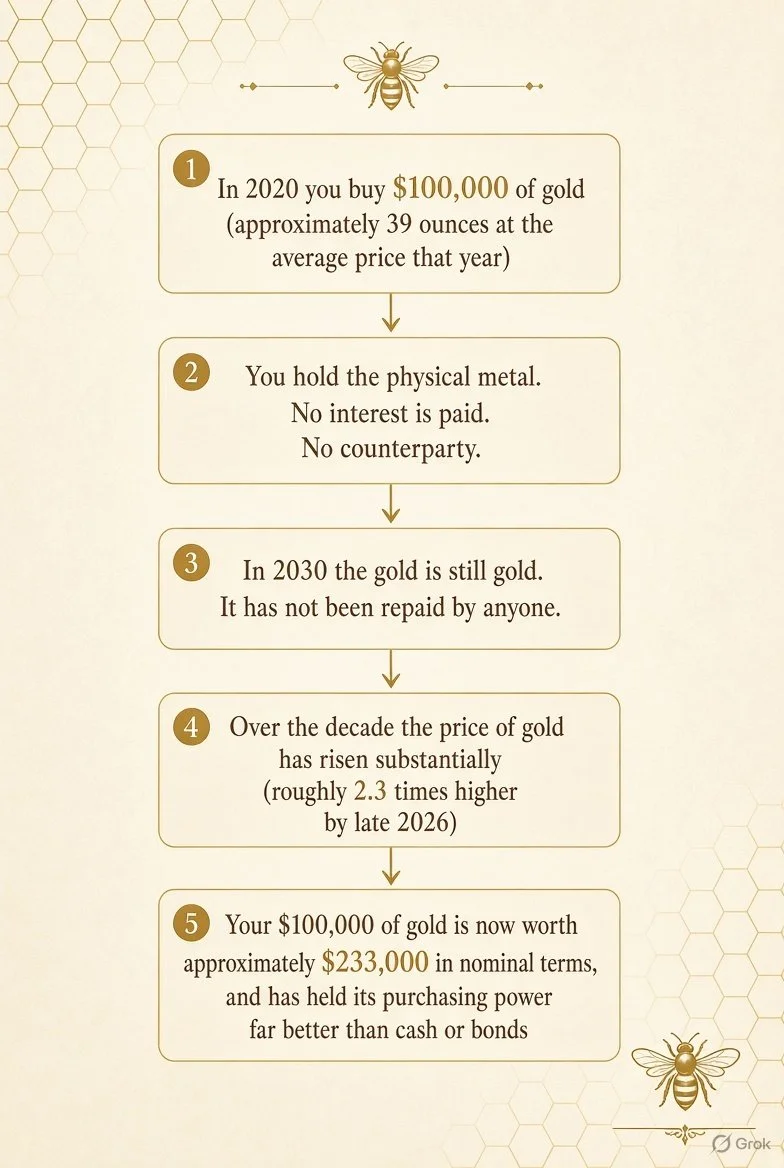
None of this is a prediction. It is just the mechanic. Governments have large debts. Inflation reduces the real value of those debts. Hard assets have historically been one of the places people have gone when they see these signals.
Now you see the signal, too.
If all of this has you wondering what you can actually do to protect your own purchasing power, I've written another piece about how to plan for buying gold silver . You can read that here.
This is education, not personal financial advice. Your decisions are yours. Do your own research. Speak to a licensed adviser if you need one.